


Linear regression is one of the simplest yet most powerful tools in a data scientist’s toolkit. 80% of data scientists use linear regression as their initial approach to predictive problems. It’s well-suited for solving problems with a clear linear relationship between the dependent variable and one or more independent variables. If you want to know when you can use linear regression, this article is for you. In this article, I’ll take you through scenarios where you can use linear regression.
Scenarios Where you can use Linear Regression
Here are some real-world scenarios where you can prefer to use linear regression.
1. Predicting Continuous Numerical Trends
Predicting continuous numerical trends involves using linear regression to forecast future values of a variable based on its historical data and relationships with other factors.
Example: Forecasting the monthly sales of a retail store based on past sales data.

In this case, linear regression can be used to model the relationship between sales (the target variable) and independent variables such as time, advertising budget, or promotional spending.
Ideal data characteristics required:
- Dependent Variable: Monthly sales (continuous numerical data).
- Independent Variables: Time and promotional factors.
In this example, Linear regression will require a clear linear relationship between predictors (e.g., advertising budget) and the target variable (e.g., sales).
2. Estimating Relationships Between Variables
Estimating relationships between variables means using linear regression to quantify how changes in one or more independent variables affect a dependent variable.
Example: Estimating the impact of price on demand for a product in different market conditions.

In this case, Linear regression can help quantify the relationship between price and demand, to enable businesses to make informed decisions about pricing and promotional offers.
Ideal data characteristics required:
- Dependent Variable: Demand (numerical).
- Independent Variables: Price, income levels, or marketing expenditure.
In this example, Linear regression will require minimal multicollinearity among predictors to ensure that each variable contributes uniquely to the model. Additionally, residuals should be independent, meaning errors in one observation (e.g., sales in one region) should not influence errors in another observation.
3. Predictive Maintenance
Predictive maintenance refers to the use of data from machinery and equipment to anticipate when maintenance will be needed to minimize downtime and reduce costs.
Example: Predicting the remaining useful life (RUL) of machinery based on operational metrics like vibration levels, temperature, and runtime.

In this case, Linear regression can be used to model the degradation of machinery performance and predict the RUL based on sensor readings.
Ideal data characteristics required:
- Dependent Variable: Remaining useful life (continuous numerical data).
- Independent Variables: Vibration levels, temperature, runtime, etc.
In this example, Linear regression will require additive relationships between predictors and the target variable to ensure that each predictor contributes independently to the target. Additionally, it will assume that both predictors and residuals are normally distributed to support accurate predictions and model stability.
4. Financial Risk Analysis
Financial risk analysis involves using historical market data, macroeconomic indicators, and other financial metrics to assess and predict portfolio performance or investment risks.
Example: Predicting returns on investment portfolios based on historical market data, asset weights, and macroeconomic indicators.
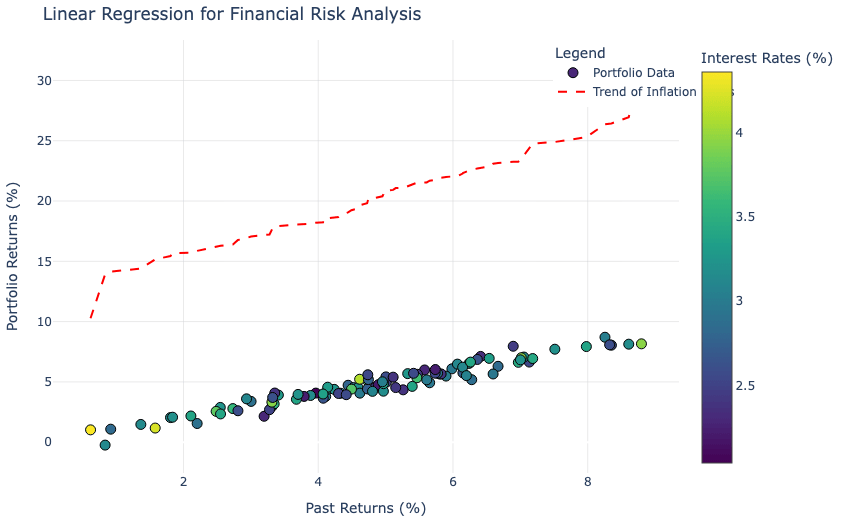
In this case, Linear regression can be used for modelling the relationship between the variables and portfolio performance.
Ideal data characteristics required:
- Dependent Variable: Portfolio returns (numerical).
- Independent Variables: Past returns, interest rates, inflation rates, etc.
In this example, Linear regression will require independence of observations, meaning that the data points should not influence each other. It will also assume homoscedasticity, where the variance of residuals remains constant across all levels of predictors, and that residuals are normally distributed for reliable statistical inference.
Summary
So, here are some real-world scenarios where you can prefer to use linear regression:
- Predicting Continuous Numerical Trends
- Estimating Relationships Between Variables
- Predictive Maintenance
- Financial Risk Analysis
I hope you liked this article on the scenarios where you can use Linear Regression. Feel free to ask valuable questions in the comments section below. You can follow me on Instagram for many more resources.


